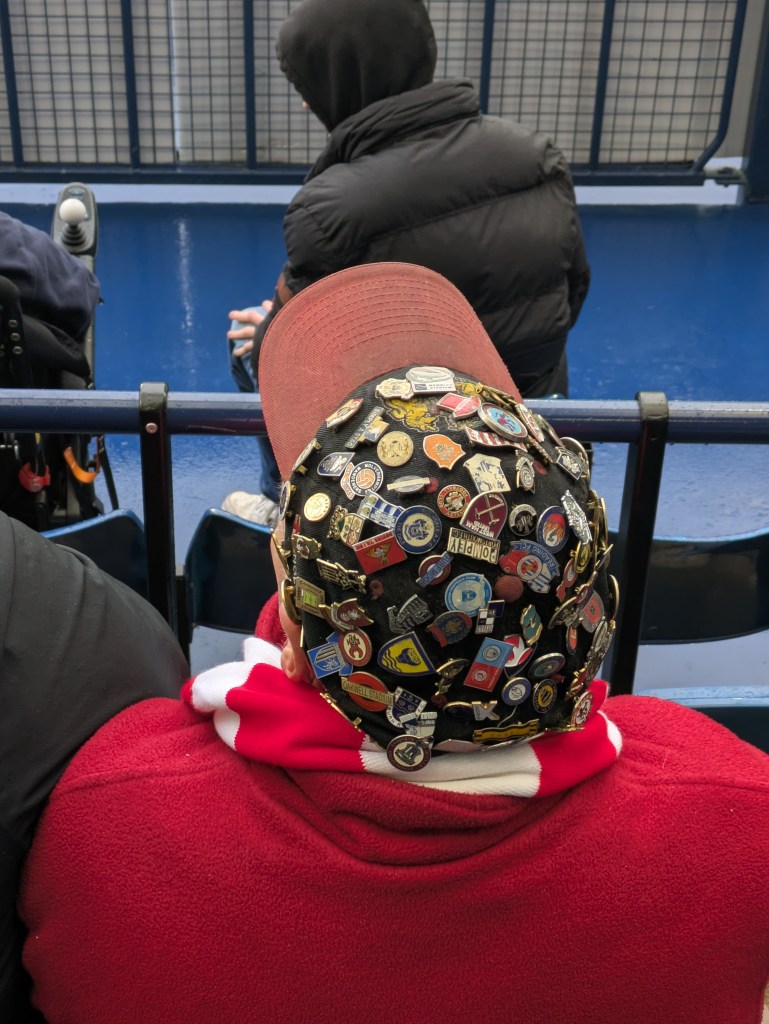
Other teams have trophies, glory. They go up and down. They yo-yo. They plummet to the depths, then get rescued by Hollywood megastars, become the subject of a global TV phenomenon, spend millions each year, transcend everything. Others fall out of the league, then rise, like Nosferatu in the doorway, confounding everyone else. Some teams do none of these things. They sit in the middle two divisions for almost all their footballing life, all their cultural history.
Living memory for Bristol City stretches back to the briefest stay in the old First division, three challenging years from 1976 to 1979, before a gravity defying fall into the basement, and a near cataclysmic financial collapse, now written into the club’s mythology through a chant sung at every match, after 8 first team players tore their contracts up before a 12.30 deadline in order to ensure the club survived.
City are now in their eleventh successive season in the Championship. The average placing is 12th out of 24. It is not possible to be anymore mid table than this; it is the one thing the club excels at, where they have the beating of all other teams. The only contenders for the mid table crown are Preston; it’s a sort of derby of middlingness. Almost all other teams have had moments in the spotlight, being elevated to the promised land, the riches of the Premier League, sometimes crashing back down, but that moment, those 5 minutes, a shared fever dream for everyone, they do not happen to us. They have things to celebrate, intoxicating moments, European titles. We have the Johnson’s Paint Trophy, the League One title, and most recently, the highest aggregate play-off defeat courtesy of Sheffield United (and Oliver Langford).
At some point it becomes a badge of honour, a statement of truth, supporting a club in the city you live, still located within the heart of the community, growing and changing with the area. There is no glory hunting, only proximity and authenticity. Some clubs hold onto this, they grow, things change beyond all recognition, prices shoot up, but the umbilical between club and place remains unbroken. Fulham stay at Craven Cottage, sure, it’s one of the most genteel away games I’ve been to, with a docile, equity-laden, satiated crowd, but the ground is still where it should be, and would be recognisable to a fan from any era of the club’s history. The forces of globalism and financial avarice have altered these realities; hence West Ham playing in a soulless ground somewhere in Stratford.
Away games increasingly become a tour of the grimmer parts of town, far away from anywhere where anyone might actually live, or be able to say, born there, brought up. Drive to Coventry, park somewhere on an industrial estate, walk across a peripheral wasteland, attempt to cross a huge arterial ring road, end up trying to find the entrance in a huge, sterile bowl, plonked in the middle of what feels like a flyover. Go to Hull, do the same. Go to Cardiff, get kettled by the police on arrival, walked through the city for an hour until the stadium looms up out of a dilapidated commercial estate on the edge of the city, spend two hours in another dispiriting blue scaffolded bowl. West Brom and the Hawthorns is where it should be, with an archaic, lovely name, a strangely mismatched, idealised stadium. It’s not in the best part of town, but it never has been, that’s by the by, at least it is rooted. The experience was still terrible though. You go to these places and hope the people that live there have a terrible day, and that you celebrate and cheer a heist. I don’t know why away games are so hard; there is no physical or empirical logic, it’s simply psychology.
It was so cold. A colleague watching on TV saw me holding my daughter close to prevent the snow from seeping into her coat. West Brom were incisive, we were terrible. We resorted to chanting ‘we’ve got the ball’, when we had the ball, and ‘we’ve lost the ball’, when we lost the ball. The kids found it funny for about 3 minutes.
The financial, globalised game, is starbucks rather than the local cafe. It gives homogeneity, in exchange for everything else, all of the roots reaching out in the community. On a Saturday, we leave the house, walk past Bristol South End road, the location of the club in the 19th century. We walk down North Street, through the community, doing Saturday things, the local businesses, turn along the park, past the new murals, and there it is, Ashton Gate. It has a new stand and an older stand and an even older stand. Under the new stand the concourse is lovely. It sells millions of cubic litres of Thatchers.
In provincial towns, parts of cities, people walk along roads they know, have routines, buy a particular pie, head to the ground, the comfort of routine, tradition, worn lightly, until suddenly it’s gone, replaced by a drive, a trek to somewhere else, somewhere unconnected, grim and alienating. In Bradford, my Mum and Ian, her partner, walk out along Bolton Road, past the Corn Dolly, into Manningham Lane, and along the Midland Road, heading to see Bradford City. I feel lukcy that neither of us have to walk along an arterial ring road to a barren stretch of porous wasteland, neither town nor countryside.
The things we celebrate: the fact that we once made it to the top division, for three years, and it then broke the club. And the cup runs, we love those. Drawing to Leeds at home in the fifth round of the FA Cup in 1974, then beating them in the replay away. The big Leeds team, the Damned United, Billy Bremner, Don Revie, this unbeaten Leeds team, for 29 games. We then lost to Liverpool in the next round. To celebrate the momentous occasion of a fifth round cup win, 50 years later, the players wore replica shirts against Leeds in the League and we lost 1-0. the shirts were very nice. In the absence of other notable events in the club’s history, this is what we celebrate. That and the club not disappearing. This is all we have.
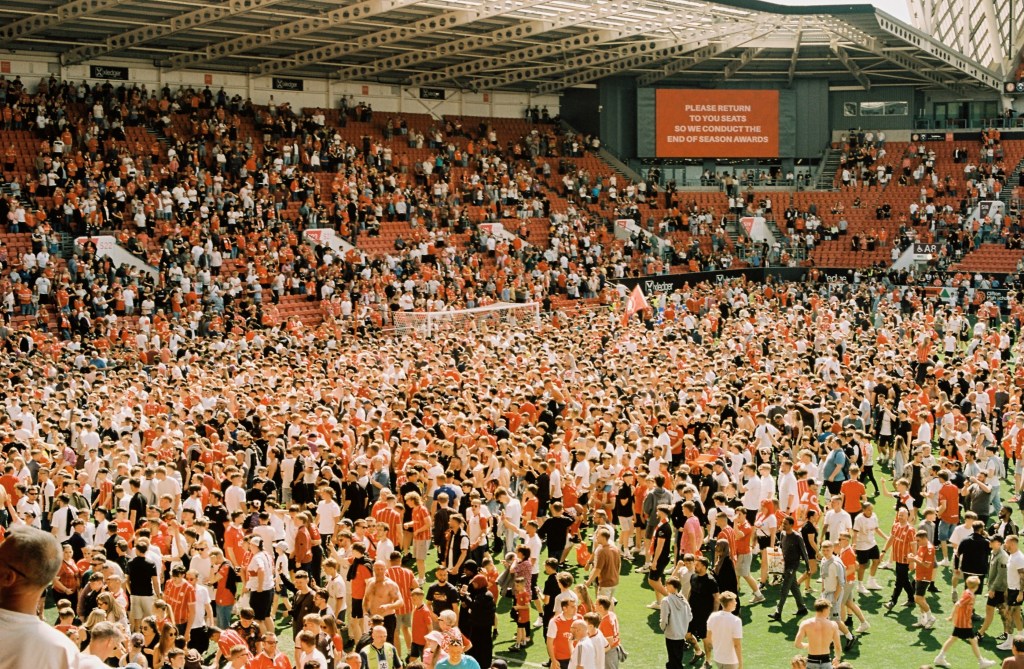
 Bristol City 1894
Leave a comment